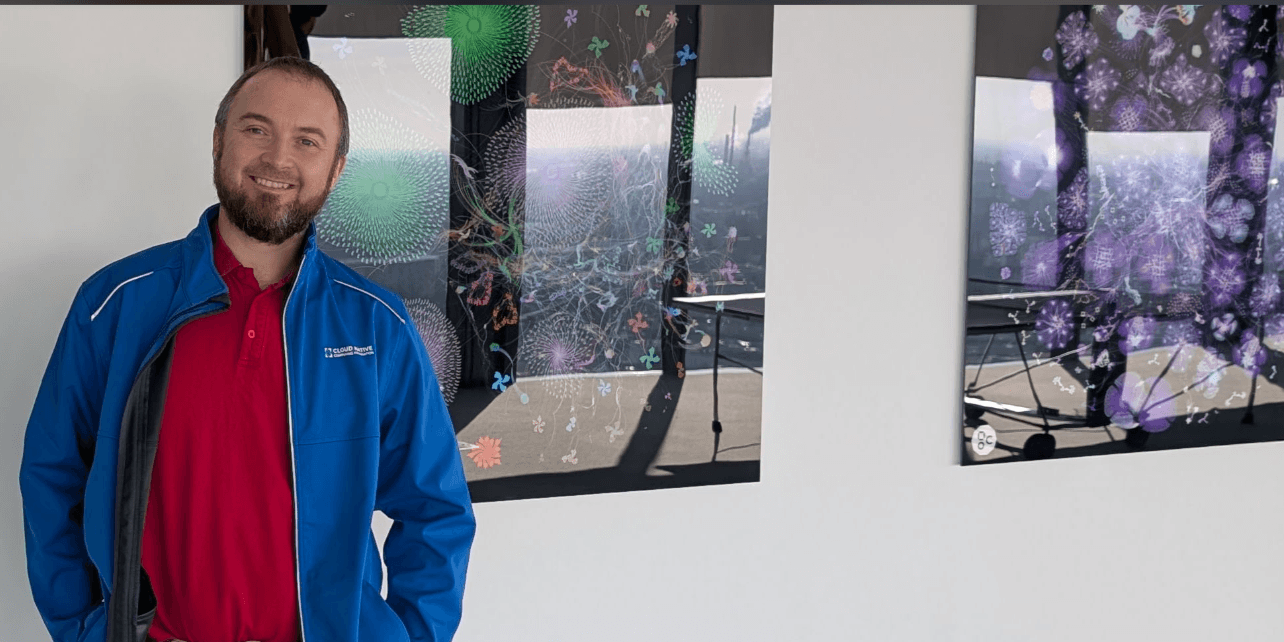
Graphcore’s Bristol office has been home to the company since it was founded in 2016. Today, many of the teams developing Graphcore’s core technology sit here, working across disciplines to support the next generation of AI computing.
As the company has grown, so have the people within it. Career paths here don’t always follow a straight line – they evolve through curiosity, conversations, and the confidence to explore new opportunities as they emerge.
We spoke to Arianna, Machine Learning Engineering Manager in Bristol, about her journey from Product Support Engineer to leadership, and how curiosity, support, and trust shaped her path along the way.
From PhD to Product
When a recruiter first mentioned Graphcore in 2018, I was completing my PhD in Surgical Robotics and hunting for software roles. I’d been curious about applying simple AI to automate robotic tasks since stumbling upon the ResNet paper, but my thesis left little time for AI-based experiments. The Product Support Engineer role at Graphcore felt like the perfect bridge: a way out of academia, a real start in AI — and a reason to move to Bristol, home of Massive Attack, one of my favourite bands since I was a teenager!
Seven years later, I’m still here, and I now lead the Inference project as ML Engineering Manager within the Applied AI team. The path that took me from being “the bug-fixing person” to owning a product-focused engineering area taught me a lot about learning, trust, and ultimately the type of leader I aspire to be.
The first job: an IPU-based gym
Back when Graphcore was building and supporting IPU hardware, I was a Product Support Engineer, and the first point of contact for IPU users. Bugs came from everywhere. On the same day there could be a NaN issue to debug in a PyTorch BERT model (this was a few years ago!) and an IPU rack at a customer’s site failing to upgrade to the latest driver version. I studied Biomedical Engineering, so I came from a different background than most of my peers, who had studied Computer Science or Electrical Engineering. This was an incredible crash course: the team was small and the problems came fast from experienced ML researchers in prestigious organisations – in other words, it was a real gym for a graduate engineer. I also particularly enjoyed talking directly to customers and working with different stakeholders across Software, Product and Research.
Those early days gave me a panoramic view of the whole stack required to run AI models on the IPUs, but I kept gravitating to the higher-level AI applications. I liked the place where research and product meet – where an idea becomes something customers can use to solve industry problems. After a few years I took on people management in the team and gradually moved toward Applied AI, where I could be at the forefront of developing and optimising the latest AI models and strategies.
Being trusted to lead
One defining moment was being asked to lead an emerging engineering project in Applied AI. Coming from a different background, not only academically, but also having just moved from a generalist team like Product Support, I didn’t feel I had all the technical depth to kick off and lead the work. However, I was sure I wanted this to become my career path, and I was keen to build my technical authority within the team. With support from my manager, I structured a learning programme to fill in the knowledge gaps, accepted that mistakes would happen, and gradually started speaking up more in meetings.
What helped most was the team. Graphcore’s collaborative, ego-free culture meant people listened and trusted my judgement as I formed a vision and translated it into concrete technical tasks. I learned to break the roadmap into milestones, assign responsibilities, and represent our product users in technical discussions, in other words, to be the ML engineer in the room. Over time my ownership grew – not just in headcount, but in the visibility and impact of the projects I led, and in my confidence to work across teams.
Tackling hard problems
One of the biggest challenges in my role as ML Engineering Manager today is the rapid evolution of the requirements my team must deliver on. AI moves fast, and the Applied AI team needs to stay at the bleeding edge of techniques and strategies to achieve efficient training and inference on Graphcore’s systems. That requires constant, rapid learning and adaptability – many problems demand deep technical thinking and careful analysis. What I enjoy most is translating high-level requirements into day-to-day operational tasks for engineers and then reconciling that work into a coherent view of progress and priorities for external stakeholders.
Working with others
I’ve been lucky to meet fantastic peers and mentors at Graphcore over the years. Having female role models who pushed me to take on new challenges was particularly important. I won’t name names, but they know who they are – they led by example and encouraged me to advocate for myself, take risks, and not question the space I deserve in the room. We became friends along the way, and I strongly believe in creating a network of trusted peers in the workplace to run ideas by and gather honest feedback from.
My approach to leadership focuses on coaching and continuous learning. I don’t believe in a directive management style, especially in a rapidly evolving field like AI. The best ideas often emerge from team brainstorming – building on one another’s skills and knowledge to reach shared solutions we can all stand behind. I try to foster an environment of openness where everyone – not just the most extroverted or confident engineers – can share their perspectives and ideas.
What keeps me going - and what’s next
The ML industry moves at lightning speed, and I love that: the challenge of keeping up the pace energises me. Looking forward, I want to keep deepening my technical understanding while continuing to shape product direction. I’m excited about expanding the impact of inference in applied settings, working directly with customers, and mentoring the next people who’ll take this work further.
Outside work, I’m a movement lover (running is the one exception!) – aerial arts and dance are my creative outlets. I also run a semi-regular stretching workshop at Graphcore; finding stillness in challenging stretches is a powerful form of mindfulness, even if my students sometimes disagree.
I’m grateful to the people who taught, challenged, and trusted me on this journey. I try to pay that forward as a peer and mentor. So, if you’re curious about inference, Applied AI (or stretching!), please do say hi – you can find me in our Bristol office.
Graphcore continues to grow, and behind every breakthrough in our technology are the people building, scaling, and evolving it – from early-career engineers to experienced leaders across the business.
If you’re interested in growing your career while tackling challenging problems alongside supportive, high-calibre teams, take a look at our current opportunities and see where you might fit.